· ReadyStack
Worked example
Real numbers from this tool, line by line.
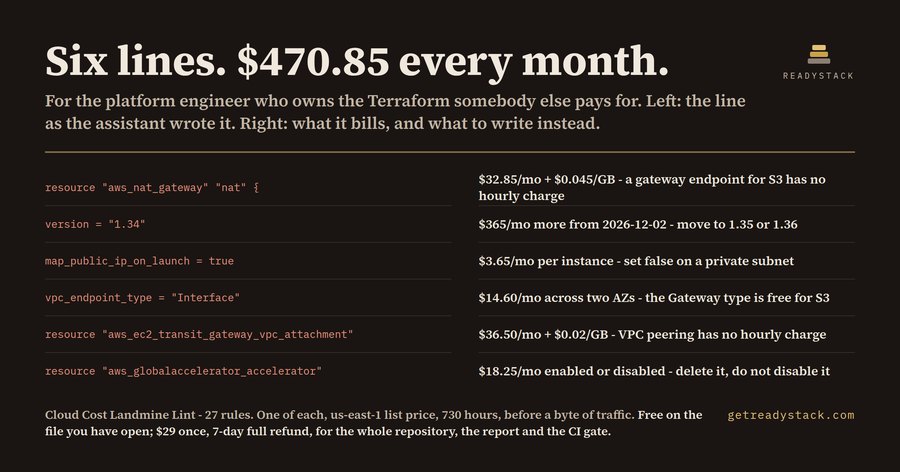
$470.85 every month, from six lines of Terraform - for the platform engineer on AWS us-east-1 who owns the module somebody else pays for. The extension's own output on that file, unedited:
line  3  [error]  map_public_ip_on_launch = true
                  A public IPv4 at $0.005 per hour, in use or idle - $3.65 a month per instance, charged since 2024-02-01
line  6  [error]  resource "aws_nat_gateway" "nat" {
                  $0.045 an hour - $32.85 a month at 730 hours - plus $0.045 for every GB it processes
line 12  [error]  version = "1.34"
                  $0.60 per cluster-hour instead of $0.10 from 2026-12-02 - $365 more a month, per cluster
line 16  [warn]   vpc_endpoint_type = "Interface"
                  $0.01 an hour per availability zone plus $0.01 per GB - about $14.60 a month across two zones
line 19  [warn]   resource "aws_ec2_transit_gateway_vpc_attachment" "spoke" {}
                  $0.05 an hour - $36.50 a month each - plus $0.02 for every GB processed
line 21  [warn]   resource "aws_globalaccelerator_accelerator" "edge" {}
                  $0.025 an hour - about $18.25 a month - whether it is enabled or disabled
--- 6 findings over 27 rules ---
$3.65 + $32.85 + $365 + $14.60 + $36.50 + $18.25 = $470.85 a month at us-east-1 list prices, 730 hours, before any traffic moves. Nothing is broken: terraform validate passes, plan is clean, and the money starts the hour you apply.
The date nobody put in the code
There is nothing wrong with version = "1.34". It was right when it was written and it is right today. On 2026-12-02 it becomes expensive: that is the day Kubernetes 1.34 leaves Amazon EKS standard support. From the start of that day, in UTC, the same untouched cluster bills $0.60 per cluster-hour instead of $0.10 - $438 a month instead of $73, $365 more every month, per cluster. The only thing that changed was the calendar.
It is already true behind you: 1.33 left standard support on 2026-07-29, 1.32 on 2026-03-23, 1.31 on 2025-11-26 - force-upgraded on 2026-11-26. A repository that pinned a version eighteen months ago has paid the higher rate ever since, and no alert fired, because nothing went wrong.
Why the assistant cannot see it
An assistant writes map_public_ip_on_launch = true for a private subnet because in most of the text it learned from, a public IPv4 was free. It stopped being free on 2024-02-01: $0.005 per hour per address, in use or idle - $3.65 a month per instance. The model is not lying; it is quoting a world that ended.
The gap runs through the other rules too. single_nat_gateway = false reads like a high-availability setting - it is also one NAT gateway per availability zone at $0.045 an hour each, $98.55 a month across three zones. gp2 is $0.10 per GB-month against $0.08 for gp3. And retention_in_days = 0 is not "no retention": it is Never Expire, at $0.50 per GB ingested.
What a cost estimator does not tell you
Cost estimators price what you asked for: they will tell you the NAT gateway costs $32.85 a month. They will not tell you the line did not have to exist, nor that a version string nobody touched changes price by itself on a date already in the calendar.
What it is
A VS Code and Open VSX extension, and a free web page that runs the identical 27 rules. Open a .tf, a CloudFormation template or a Kubernetes manifest: every line that starts a standing charge is named, with its published us-east-1 price and, where the price moves on a date, the date.
Checking the file you have open is free and complete - all 27 rules, no key, no limit, no watermark. The licence covers a different job: every file in the repository at once, a CSV, JSON or HTML report for a budget review, and machine output that exits non-zero so a pipeline can stop a merge that adds a standing charge. $29 once, one licence key per person or team seat, 7-day full refund.
15 seconds — what it actually does
Questions people ask
What does Cloud Cost Landmine Lint actually do?
It reads the Terraform, CloudFormation, Kubernetes or compose file you have open and names every line that starts a charge which keeps running after you close the editor. Each finding carries the published us-east-1 unit price and, where the price changes on a fixed date, that date. It ships 27 rules.
Who is this for?
Platform, DevOps and SRE engineers who write the infrastructure code somebody else pays the bill for. It is aimed at the person reviewing a module an assistant generated, or a pull request that adds one NAT gateway per availability zone, and who will be asked in four weeks why the account grew.
Why can I not just ask a chatbot whether my Terraform is expensive?
Because the assistant writes map_public_ip_on_launch = true, which was free until 2024-02-01 and now costs $0.005 an hour per address, and it has no calendar. It cannot know that a version string you have not touched, Kubernetes 1.34, starts billing $0.60 a cluster-hour instead of $0.10 on 2026-12-02.
What is free and what needs a licence key?
Checking the file you have open is free and complete: all 27 rules run, every finding shows its price and its date, and nothing is hidden, watermarked or time-limited. The licence covers a different job entirely - every file in the repository at once, a CSV, JSON or HTML report, and machine output that fails a build.
How does $29 compare with getting one of these lines wrong?
The extension is 29 US dollars once,. Amazon's published price for a cluster past its standard support date is $0.60 per cluster-hour against $0.10, which is $365 more every month, per cluster, forever. A single forgotten NAT gateway is $32.85 a month on its own.
Why not just ask ChatGPT or another AI chat?
A general AI chat answers from training data with a cutoff date, cannot read your repository and names no rule version. Terraform Cost Lint - cloud cost landmines (Terraform, Cloud checks the file you open against 27 rules from a rule set dated 2026-09-20, and points at the exact line with the fix. For a filing, an audit or a client you need that dated result on your own files.
Ask about this tool
One question, answered by the person who built it. Your email only if you want the answer sent.